
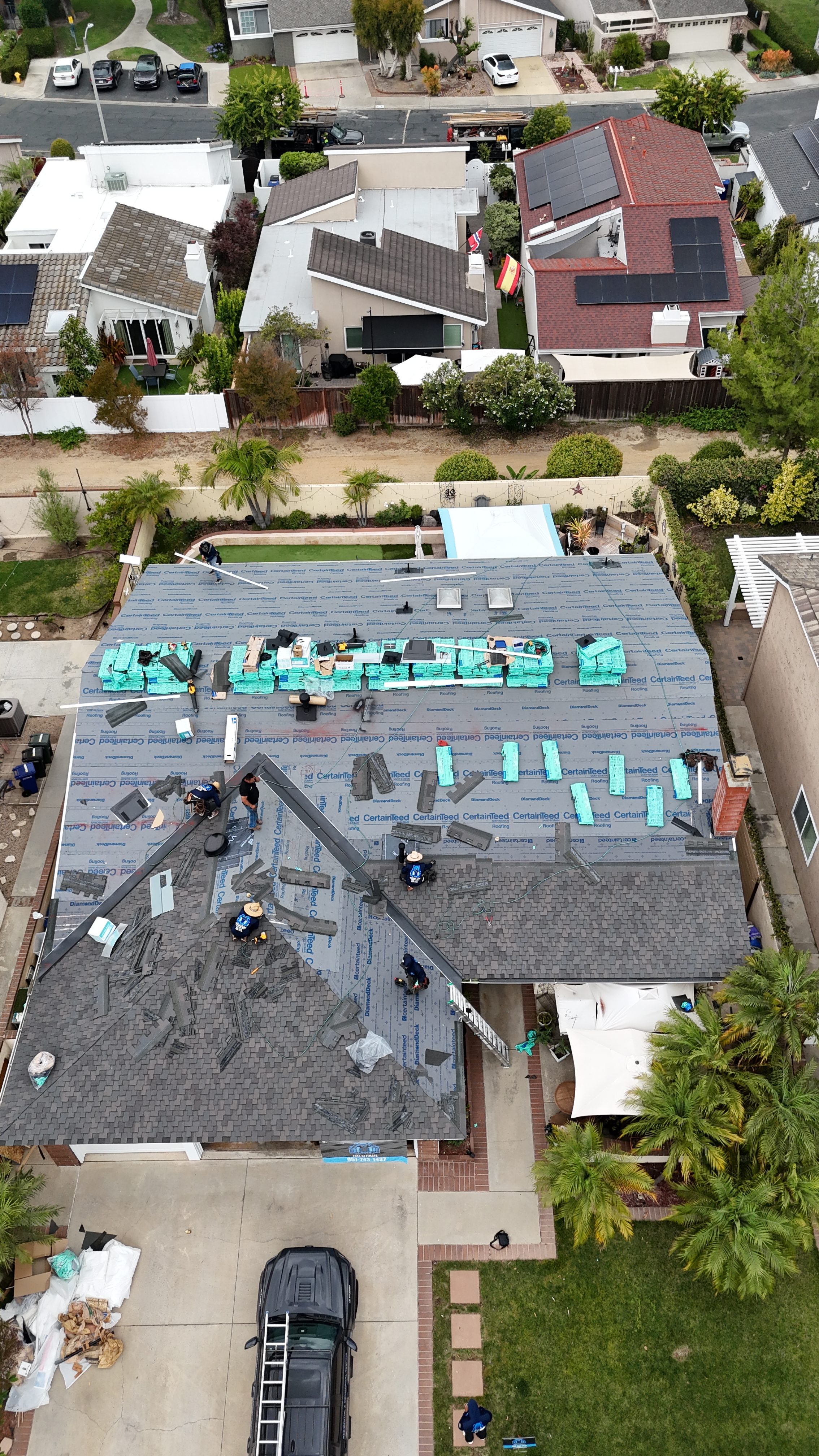
Most of the roofing guidance published about Huntington Beach focuses on HOA compliance — the architectural review requirements of Seacliff, the material standards of Edwards Hill, the governance processes of Huntington Harbour’s residential associations. And for homeowners in those communities, that guidance is essential. But it misses a significant portion of Huntington Beach’s residential landscape entirely.
The majority of Huntington Beach’s residential properties — particularly the vast mid-city neighborhoods spanning Old Town HB, the areas surrounding Huntington Central Park, Newland Street, Garfield Avenue, Adams Avenue, Indianapolis Avenue, Talbert Avenue, Warner Avenue, and the flatland tracts between Beach Boulevard and Goldenwest Street — are not governed by HOAs. These neighborhoods contain tens of thousands of Huntington Beach homes where roofing decisions are made entirely by the homeowner, governed only by the City of Huntington Beach’s building code requirements and California’s statewide standards.
That freedom is genuine and meaningful. Non-HOA Huntington Beach homeowners can choose any roofing material that meets code requirements, any color, any profile, on any schedule that suits them — without architectural review processes, submission requirements, or committee approval timelines. But freedom from HOA governance does not mean freedom from complexity. Non-HOA HB homeowners face the full force of Huntington Beach’s coastal environment, their city’s permit requirements, and the specific challenges of their neighborhoods’ housing stock — without the HOA guardrails that, despite their bureaucratic burden, also prevent some of the worst material and contractor choices that homeowners make when left entirely without guidance.
We are Cali Roofing Solutions — a family-owned GAF Master Elite®️ and CertainTeed SELECT ShingleMaster™️ Premier certified roofing contractor based in Corona, CA, serving all of Huntington Beach and Orange County and greater Los Angeles. We back every project with a 30-Year Labor Warranty and 50-Year Material Warranty. This guide is written specifically for non-HOA Huntington Beach homeowners — the majority of HB’s residential market — who make roofing decisions in a context that nobody is writing specifically for them.
The Non-HOA HB Roofing Landscape: What You Are Actually Working With
Understanding the specific roofing context of Huntington Beach’s non-HOA neighborhoods requires understanding three realities that define the decision environment for most HB homeowners.
Reality 1: These Are Among the Oldest Homes in HB
Huntington Beach’s non-HOA residential neighborhoods are predominantly older than its planned community counterparts. The HOA-governed communities — Seacliff, Edwards Hill, Brightwater — were developed primarily from the 1970s through the 2000s as master-planned developments where the HOA structure was established as part of the original development framework. The non-HOA flatland neighborhoods that surround them were developed earlier — Old Town HB and the neighborhoods closest to the beach and downtown were largely built between 1945 and 1975, with the inland flatland tracts filled in during the 1960s and 1970s.
This means that HB’s non-HOA neighborhoods contain the city’s oldest housing stock — properties that are now 50 to 80 years old, with roofing systems that have been replaced multiple times since original construction, structural framing from an era when lightweight materials were the norm, and accumulated histories of modification, repair, and reroofing that have created complex assemblies that require investigation rather than assumption.
Reality 2: The Coastal Environment Applies Fully — Without HOA Specification Guardrails
Non-HOA HB homeowners face the same coastal salt air, marine layer moisture, and UV amplification conditions that affect every Huntington Beach property. What they lack is the HOA specification requirement that forces HOA-community homeowners toward materials and specifications appropriate for the coastal environment — even when those homeowners might prefer a cheaper option.
In Seacliff, HOA requirements mandate tile roofing — which means homeowners there are using a material appropriate for their coastal environment whether they understand coastal material science or not. In the non-HOA neighborhoods of Central HB, a homeowner can install the cheapest available asphalt shingle product with standard electro-galvanized fasteners and standard galvanized flashing — a specification that will underperform dramatically in HB’s coastal conditions and deliver a fraction of the product’s rated lifespan. No HOA is preventing that choice. The contractor who gets the job at the lowest price is not obligated to explain why it is inappropriate. And the homeowner who did not know to ask the right questions will discover the consequences in 8–12 years rather than the 25–30 they expected.
Reality 3: Full Material Freedom Requires Informed Decision-Making
Non-HOA HB homeowners can choose any code-compliant roofing material — asphalt shingles, concrete tile, clay tile, standing seam metal, TPO membrane on flat sections — in any color and profile they prefer. This freedom is valuable and real. It also requires that the homeowner understand enough about roofing materials to make choices appropriate for their property’s specific situation — structural capacity, coastal exposure proximity, budget horizon, and aesthetic preferences — rather than defaulting to the cheapest available option or accepting a contractor’s recommendation without the context to evaluate it.
This guide gives non-HOA HB homeowners the information needed to exercise their material freedom with the knowledge required to make choices that serve their property well.
Non-HOA HB Neighborhoods: Specific Roofing Profiles
Old Town Huntington Beach
Old Town HB — the historic residential grid immediately north and east of the Downtown commercial core, bounded roughly by Palm Avenue, 17th Street, Garfield Avenue, and Beach Boulevard — contains some of Huntington Beach’s most characterful residential properties and its most architecturally diverse housing stock. Original beach cottages from the 1920s and 1930s share blocks with postwar bungalows, 1960s ranch homes, and scattered contemporary infill developments that have replaced older structures on desirable lots.
The roofing challenges specific to Old Town HB:
- Structural diversity requiring individual assessment: The wide range of original construction vintages and structural types in Old Town means that no standardized material recommendation applies across the neighborhood. A 1928 beach cottage may have original framing designed for wood shake that cannot support tile without structural modification. A 1965 ranch home may be structurally appropriate for tile. Each property requires individual structural assessment before material specification.
- Proximity to the ocean: Old Town’s position within walking distance of the Pacific places it firmly in Zone 2 coastal proximity — elevated salt air corrosion conditions that require marine-appropriate fastener and flashing specifications rather than standard inland products. Stainless steel or hot-dip galvanized fasteners and aluminum flashing are the minimum appropriate specifications for Old Town HB roofing.
- Small lot density and access: Old Town’s tight residential grid — similar to Balboa Island in Newport Beach — limits material staging and equipment access in ways that add logistical complexity to roofing projects and that favor contractors with experience managing constrained-access urban residential projects.
- Architectural character and resale positioning: Old Town HB has become one of the most desirable residential areas in the city — walkability, beach proximity, and neighborhood character driving strong property values. Roofing decisions that preserve or enhance Old Town properties’ architectural character support the investment that these values represent.
Central Huntington Beach — The Core Non-HOA Market
The broad middle of Huntington Beach’s non-HOA residential geography — the flatland tracts between Beach Boulevard and Goldenwest Street, from Garfield Avenue south to Adams Avenue and beyond — contains the city’s largest concentration of non-HOA residential properties. These neighborhoods were built primarily from the late 1950s through the early 1970s and contain predominantly single-story and two-story ranch homes with concrete tile or asphalt shingle roofing systems that are now 50 to 65 years old.
The roofing profile most commonly encountered in Central HB’s non-HOA neighborhoods in 2026: homes that have been reroofed once or twice since original construction, with the most recent reroofing occurring in the 1980s through early 2000s. Those reroofing projects used felt paper underlayment that is now 25–40 years old — at or significantly past functional end of life in many cases. The tile or shingle surfaces above these expired underlayments look variable depending on the specific material installed, but the waterproofing system the roofing assembly depends on has in many cases been non-functional for years.
Non-HOA status means that Central HB homeowners can choose their replacement material freely. The guidance for most Central HB properties: premium asphalt shingles with coastal-appropriate specifications are the most cost-effective and structurally appropriate choice for homes in this area, unless structural assessment specifically confirms tile capacity and the homeowner has a clear preference and budget for tile.
West Huntington Beach and Beach-Adjacent Non-HOA Properties
The non-HOA residential properties west of Beach Boulevard and closer to the Pacific — including the neighborhoods along Goldenwest Street, Gothard Street, and the residential tracts between Ellis Avenue and Talbert Avenue approaching the coast — experience elevated coastal conditions relative to inland Central HB and require specifications that reflect their proximity to the marine environment.
For West HB non-HOA properties within approximately 1,500 feet of the ocean or tidal waterways, the coastal specification requirements discussed in previous Huntington Beach guides apply: hot-dip galvanized or stainless steel fasteners, aluminum or stainless steel flashing at all penetrations, and premium product specifications rather than standard grade regardless of the absence of HOA oversight that might otherwise enforce these choices.
Inland Non-HOA HB — East of Beach Boulevard
The non-HOA residential communities east of Beach Boulevard — including the tracts along Brookhurst Street, Magnolia Street, Ward Street, and the neighborhoods approaching Fountain Valley — experience moderated coastal conditions relative to west-of-Beach-Boulevard properties while still carrying the marine layer moisture and salt air influence that distinguishes all of Huntington Beach from fully inland OC communities.
For inland non-HOA HB properties, coastal-specification upgrades — aluminum flashing, hot-dip galvanized fasteners — remain appropriate even though the extreme coastal protocol of Zone 1 beachfront properties is not required. The marine layer that rolls through Huntington Beach nightly affects inland HB properties meaningfully, and the modest cost premium of coastal-appropriate specifications is justified by the extended component lifespan it delivers relative to standard inland products in this environment.
The Material Freedom Decision: What Non-HOA HB Homeowners Should Actually Choose
Without HOA requirements constraining material choices, non-HOA HB homeowners are free to select the material that best fits their property’s structural situation, their coastal proximity, their budget, and their aesthetic preferences. Here is honest guidance on how that decision should be made.
Assess Structural Capacity Before Selecting Material
The most consequential material decision variable for older non-HOA HB homes — particularly those built before 1975 — is structural capacity. Homes in this vintage range in Central and West HB were frequently built with framing designed for lightweight materials. Before specifying tile roofing on any older HB home that is currently shingle-roofed or where the current tile installation’s structural adequacy has never been assessed, structural capacity confirmation is the correct first step.
The structural assessment question is specific: can this framing carry tile roofing loads — 900–1,000 lbs per square for concrete tile, 600–1,000 lbs for clay — without modification? Professional assessment answers this question. Assumption does not.
Let Coastal Proximity Drive Specification Decisions
For non-HOA HB homeowners choosing between otherwise comparable products, coastal proximity is the most important differentiating variable. A homeowner in Old Town HB three blocks from the beach should specify clay tile over concrete if tile is appropriate for their structure, aluminum flashing over galvanized steel, and stainless steel fasteners as standard — regardless of the higher cost versus standard specifications. A homeowner in inland HB east of Beach Boulevard has more flexibility on specification tier while still benefiting from coastal-grade upgrades relative to fully inland products.
Resist the Temptation of the Lowest Bid
Non-HOA status removes the HOA review process that, in HOA communities, acts as a partial check on egregiously substandard contractor specifications. The homeowner in a non-HOA neighborhood has no such backstop — the contractor who wins with the lowest bid by specifying inland-grade products at coastal properties, using electro-galvanized fasteners where stainless is appropriate, or omitting permit fees from the estimate faces no governance review. The consequences of these shortcuts fall entirely on the homeowner in the form of premature material failure, insurance complications from unpermitted work, and the absence of warranty coverage on an installation that was not performed to the standard the warranty requires.
The protection: understand the specification components that matter — fastener type, flashing material, underlayment product, permit inclusion — and confirm them in writing in every estimate you receive. Three estimates that specify identical scope can be meaningfully compared on price. Three estimates with different specifications are not comparable and cannot be evaluated on price alone.
City of Huntington Beach Requirements for Non-HOA Roofing
While non-HOA Huntington Beach homeowners are free from HOA architectural review, they are fully subject to City of Huntington Beach building code requirements — and those requirements are the same for non-HOA and HOA properties throughout the city.
Building permit requirement: Full roof replacement in Huntington Beach requires a City of Huntington Beach building permit regardless of HOA status. This is not optional and the consequences of unpermitted roofing work in Huntington Beach’s active real estate market are real — mandatory disclosure requirements, lender complications, and buyer credit demands at property sale. Cali Roofing Solutions manages the complete City of Huntington Beach permit process on every project.
Title 24 cool roof compliance: California Title 24 energy code cool roof requirements apply to re-roofing in Huntington Beach regardless of HOA status. Proposed roofing products must meet minimum solar reflectance and thermal emittance standards for Huntington Beach’s applicable climate zone — and compliance documentation must be included in the permit application. Non-HOA status does not create any exemption from Title 24 requirements.
Class A fire rating: California requires Class A fire-rated roofing on all residential structures. Every product Cali Roofing Solutions installs in Huntington Beach carries Class A fire rating — in HOA and non-HOA neighborhoods alike.
Coastal Zone considerations: Many of Huntington Beach’s non-HOA properties — particularly in Old Town HB, West HB, and the beach-adjacent flatland tracts — fall within the California Coastal Zone. Standard like-for-like roof replacement in the Coastal Zone is generally exempt from California Coastal Commission CDP requirements. Projects involving changes to roof profile, height, or configuration in conjunction with other structural modifications should confirm CDP applicability with the City of Huntington Beach before proceeding.
The Permit Process for Non-HOA HB Homeowners: A Simpler Path
One genuine advantage of non-HOA status that deserves acknowledgment: the permit process for non-HOA HB roofing is simpler and faster than the combined HOA approval plus city permit process that HOA-community homeowners navigate. Without an HOA submission to prepare, review to wait for, and written approval to obtain before permit application, the non-HOA HB project timeline from contractor selection to installation start is typically 2–3 weeks shorter than an equivalent HOA-community project.
City of Huntington Beach residential roofing permits for standard re-roofing projects process within 1–2 weeks in 2026 — a streamlined timeline that benefits non-HOA homeowners who can proceed directly from contractor selection to permit application without an intervening HOA review cycle.
The shorter process timeline does not mean a less important process. The City of Huntington Beach’s building inspection at permit completion verifies code compliance — a verification that protects non-HOA homeowners whose only governance check on contractor performance is the city inspection rather than the combination of HOA review and city inspection that HOA-community homeowners receive.
Real Installed Costs for Non-HOA HB Homes in 2026
Installed costs for a standard 2,000 sq. ft. non-HOA Huntington Beach home, including full tear-off, new underlayment, coastal-appropriate specifications, disposal, and City of HB permit:
- Premium Architectural Asphalt Shingles (GAF Timberline HDZ / CertainTeed Landmark PRO) with coastal specifications: $15,500 – $25,000
- Concrete Tile with coastal specifications: $18,500 – $30,500
- Clay Tile with coastal specifications: $23,000 – $36,000
- Standing Seam Aluminum: $43,000 – $60,000
- TPO membrane (flat roof sections): $8.50 – $14.00 per square foot installed
The coastal specification premium — stainless steel or hot-dip galvanized fasteners, aluminum flashing throughout — typically adds $800–$2,500 to project cost compared to standard inland specifications. For non-HOA HB homeowners who are tempted to accept standard inland specifications to reduce cost, this comparison is the right financial frame: a $1,500 specification upgrade versus the cost of premature component failure and early replacement on a coastal property is not a close decision.
Schedule Your Free Non-HOA Huntington Beach Roof Inspection
Cali Roofing Solutions provides free professional roof inspections with written condition reports throughout all of Huntington Beach’s non-HOA neighborhoods — including Old Town HB, Central HB, West HB, the Newland Street corridor, Garfield Avenue neighborhoods, Adams Avenue tracts, Talbert Avenue communities, Warner Avenue neighborhoods, and all non-HOA residential areas throughout the city.
Our non-HOA HB inspections specifically address structural capacity assessment for material selection decisions, coastal proximity-appropriate specification guidance, and the honest condition assessment that gives non-HOA homeowners the information needed to make genuinely informed material and timing decisions without HOA specifications to guide them.
- GAF Master Elite®️ Contractor — top 3% of roofing contractors in the United States
- CertainTeed SELECT ShingleMaster™️ Premier Contractor
- 30-Year Labor Warranty on every project
- 50-Year Material Warranty on every project
- Complete City of Huntington Beach permit management on every project
- Coastal-appropriate specifications standard on all HB projects regardless of HOA status
- Structural assessment coordination for older HB homes considering material changes
- Licensed, insured employees — no unlicensed subcontractors, ever
- Honest assessments — we will never recommend work you do not need
📞 Call (951) 743-1437 or visit caliroofingsolutions.com to schedule your free Huntington Beach roof inspection today. Proudly serving all of Huntington Beach and Orange County and greater Los Angeles.
Leave a Reply