
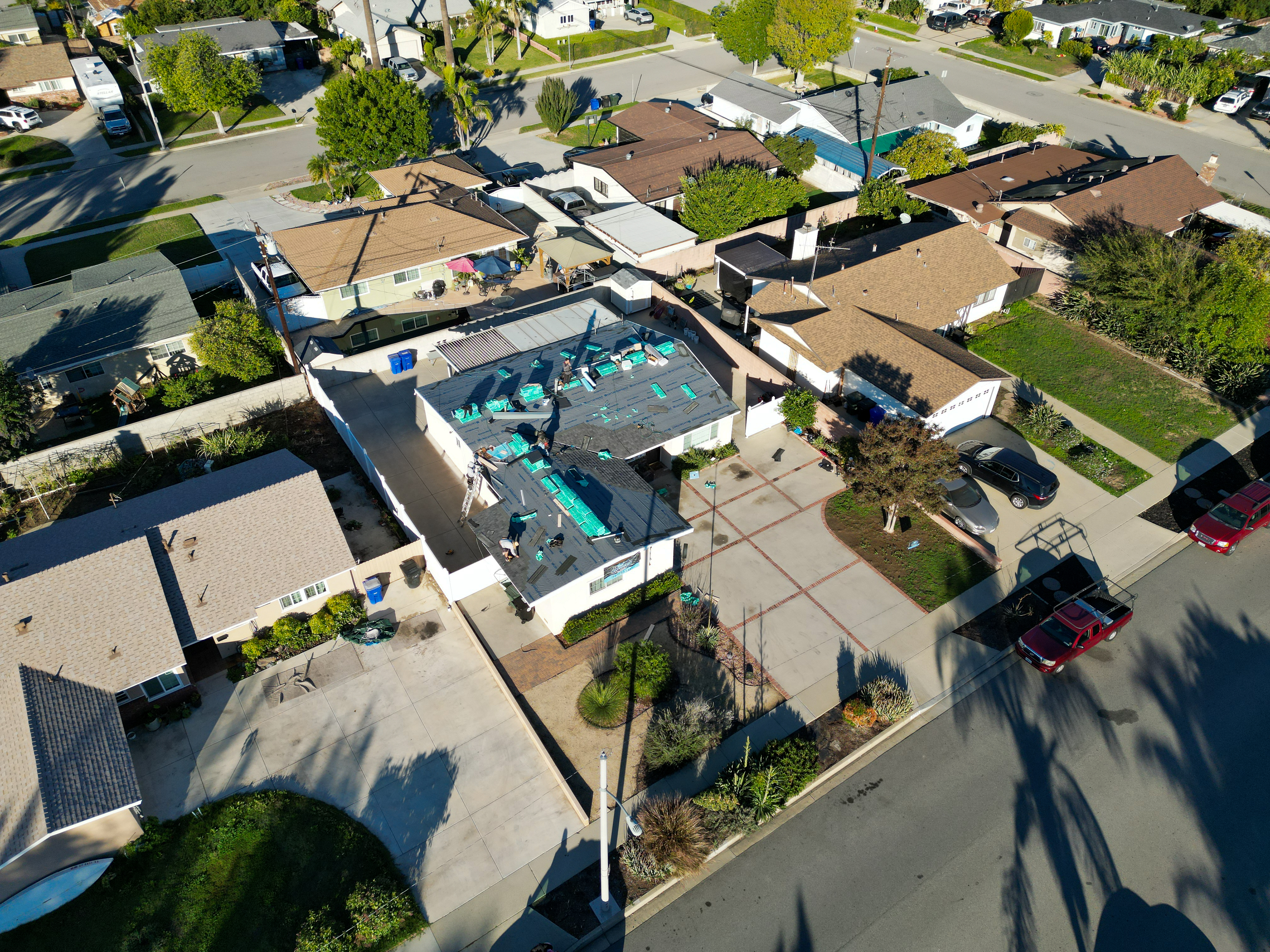
Corona del Mar occupies a singular position in Orange County’s residential landscape. Tucked between the Pacific Ocean, Newport Harbor, and the San Joaquin Hills, this small but extraordinarily valuable community — roughly one square mile in area — contains one of the most architecturally diverse and financially significant housing stocks in California. On a single CDM block you might find a 1925 beach cottage on a 25-foot lot, a 1970s ranch home with harbor views on a 5,000 square foot parcel, and a 2022 contemporary custom rebuild worth $6 million — each with fundamentally different roofing needs, different regulatory considerations, and different performance requirements.
That density of architectural diversity, combined with CDM’s position as one of Newport Beach’s most intensely coastal neighborhoods, creates a roofing environment that rewards preparation and expertise in ways that few other OC communities do. Corona del Mar homeowners who approach a roofing project without understanding their specific property’s context — its age, its construction history, its coastal exposure, its position relative to the Coastal Zone boundary, and its relationship to the village’s evolving architectural character — frequently encounter complications that a more informed approach would have prevented.
We are Cali Roofing Solutions — a family-owned GAF Master Elite®️ and CertainTeed SELECT ShingleMaster™️ Premier certified roofing contractor based in Corona, CA, serving Corona del Mar, Newport Beach, and all of Orange County and greater Los Angeles. We back every project with a 30-Year Labor Warranty and 50-Year Material Warranty. This guide addresses the roofing context of Corona del Mar specifically — because CDM deserves its own conversation.
Understanding Corona del Mar’s Roofing Context
Before addressing materials, costs, or process, CDM homeowners benefit from understanding three contextual realities that shape every roofing decision in the village.
The Coastal Zone Reality
The vast majority of Corona del Mar’s residential properties fall within the California Coastal Zone — a designated geographic area where the California Coastal Act requires that certain types of development be evaluated for consistency with coastal resource protection policies. For roofing, the practical implication is nuanced but important:
Standard like-for-like roof replacement — replacing existing roofing with the same or equivalent materials in the same configuration — is categorically exempt from Coastal Development Permit requirements under maintenance and repair exemptions in the Coastal Act. A CDM homeowner replacing their existing tile roof with new tile, or their existing shingle roof with new shingles, does not need a Coastal Development Permit from the California Coastal Commission.
Projects that change the roof’s profile, height, or configuration — or that are performed in conjunction with additions or significant structural modifications to a coastal zone property — may require a Coastal Development Permit, typically processed through the City of Newport Beach as a local coastal permit. CDM homeowners planning roofing work alongside other improvements should confirm the combined project’s coastal permit requirements with the City of Newport Beach Community Development Department before committing to scope.
The practical guidance: For a standard CDM roof replacement, Coastal Commission permitting is almost never required. For CDM improvement projects that touch the roof as part of a larger scope, confirmation of coastal permit requirements before signing any contracts is essential.
CDM’s Architectural Transformation and Its Roofing Implications
Corona del Mar has been undergoing a sustained architectural transformation for the past 15 years. The teardown-and-rebuild cycle that is replacing the village’s older cottage and mid-century housing stock with contemporary custom homes has created a visual environment where traditional and contemporary architectural languages exist in close proximity — often on adjacent lots.
This transformation has specific roofing implications for CDM homeowners with existing older structures. As the neighborhood character evolves around them, the roofing choices that were contextually appropriate for a 1965 ranch home in a neighborhood of similar structures may look increasingly mismatched in a block that now includes three contemporary custom rebuilds. This is not a code issue — it is an aesthetic and property value consideration that increasingly affects how CDM properties are perceived in the market.
CDM homeowners with older structures approaching reroofing decisions benefit from considering not just the functional replacement question — what material replaces my existing roof most cost-effectively — but the strategic question: does this reroofing project represent an opportunity to advance my property’s positioning in CDM’s evolving market?
CDM’s Coastal Exposure Profile
Corona del Mar’s relationship with the Pacific is direct and unmediated. The village’s western boundary is the ocean bluff above the CDM State Beach. Its harbor-side properties look directly across Newport Harbor’s entrance channel. Pacific weather — marine layer, salt air, fog, and westerly wind — arrives at CDM from the ocean without the several-mile buffer that slightly inland Newport Beach communities enjoy.
This direct coastal exposure means that every metal component of a CDM roofing system faces more aggressive corrosion conditions than comparable components in Irvine, Yorba Linda, or even inland Newport Beach neighborhoods. The corrosion-resistant specifications that are important throughout Newport Beach become essentially mandatory in CDM — not as an upgrade but as the baseline appropriate standard for any roofing installation in the village.
CDM’s Housing Stock and Its Roofing Profile
Corona del Mar’s housing stock can be roughly organized into three generations, each with distinct roofing characteristics and needs in 2026.
Pre-1960 CDM Cottages and Beach Houses
The original CDM housing stock — the beach cottages, craftsman bungalows, and early California ranch homes that defined the village through the mid-20th century — represents the most structurally complex and roofing-historically uncertain properties in the neighborhood. Many of these homes have been modified, expanded, and reroofed multiple times since original construction, creating layered assemblies with mixed materials, varying decking conditions, and penetration histories that span generations of different contractors and standards.
Original CDM cottage framing from the 1920s through 1940s was typically designed for wood shake or lightweight composition roofing — materials that weigh 200–350 lbs per roofing square. Installing concrete tile (900–1,000 lbs/square) or clay tile (600–1,000 lbs/square) on these structures without structural engineering assessment is not appropriate. The visual appeal of tile roofing in CDM’s coastal context is understandable — but the structural assessment step is non-negotiable on structures of this age and original design specification.
For pre-1960 CDM properties, the professional reroofing process includes a pre-project attic investigation documenting decking type and condition, framing configuration, existing layer count, and eave condition — followed by a structural assessment if any material upgrade is being
Leave a Reply